
Carnegie Mellon University · Catalyst Group

Yiyan Zhai

Building efficient ML systems
and embodied models.

I'm a first-year PhD student at Carnegie Mellon University, advised by Tianqi Chen and Zhihao Jia. I received my B.S. in computer science from CMU. I work on embodied models, agentic GPU programming, LLM inference, and storage systems. I also collaborate with Juncheng Yang at Harvard SEAS on cache replacement and resilient routing for LLM inference.

Feel free to email me if you’d like to chat about research or explore a collaboration.

Email yiyanz [at] andrew [dot] cmu [dot] edu

Yiyan Zhai
Pittsburgh, Pennsylvania

Research & projects

GPU programming, language models, and caching.

Agentic GPU programming

TIRx Harness

An open-source environment that helps AI agents write, debug, and optimize GPU kernels. It combines the TIRx compiler foundation with a kernel knowledge base, analysis tools, and a benchmark server.
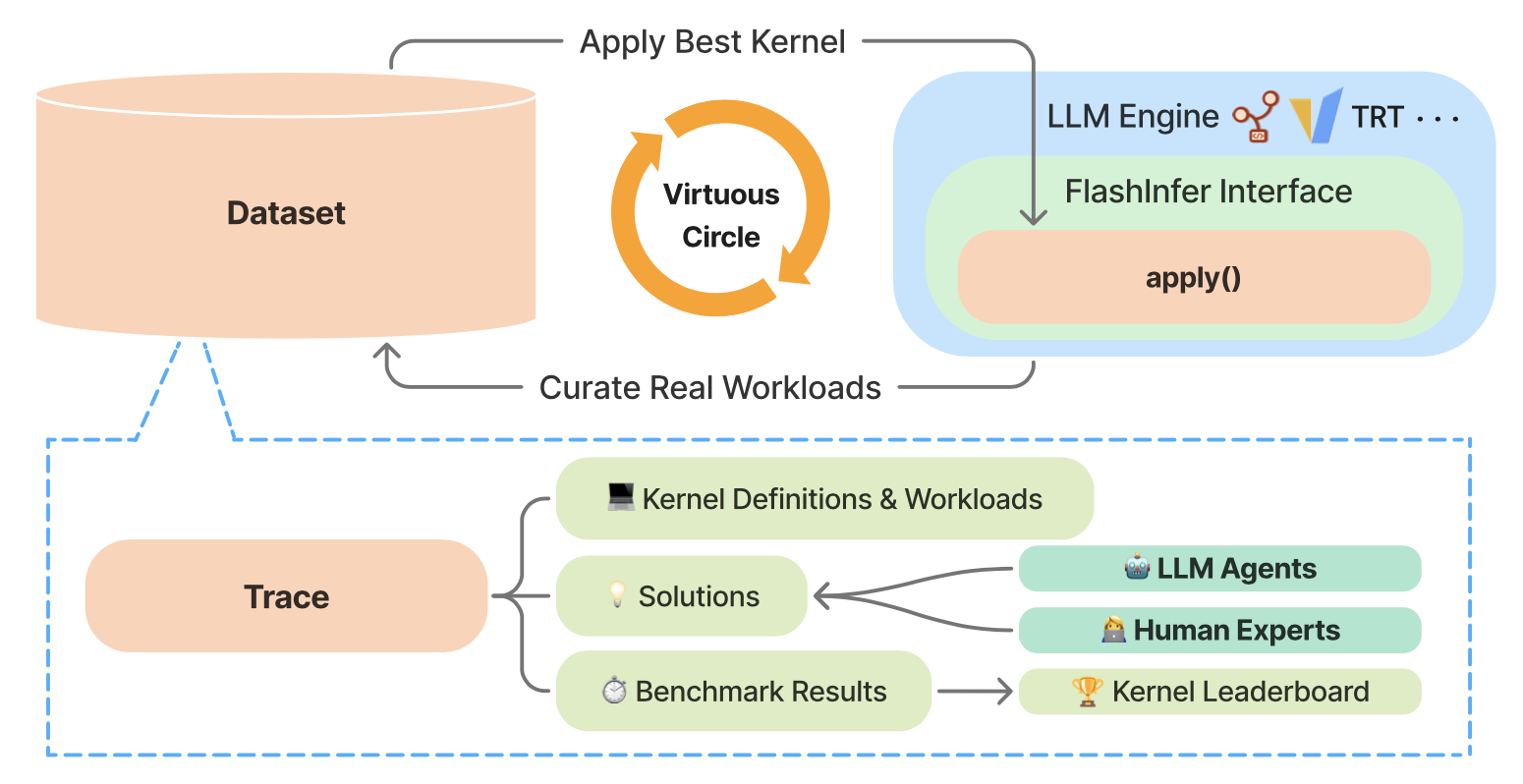
FlashInfer-Bench overview connecting GPU kernel generation, evaluation, and deployment
MLSys 2026 · GPU Kernel Benchmarking

FlashInfer-Bench

FlashInfer-Bench evaluates AI-generated GPU kernels on real LLM serving workloads and makes them easy to deploy. It checks correctness and performance, then enables kernel replacement in FlashInfer, SGLang, and vLLM.

VLDB 2026 · Caching & Storage Systems

Clock2Q+

A cache replacement algorithm designed for metadata in VMware vSAN. It distinguishes short bursts of access from reuse over time, helping the cache retain useful blocks and reduce misses with low overhead.

WebLLM Assistant
Language models.
Right in your browser.
Overleaf   +   Google Workspace   +   WebLLM
In-browser AI

WebLLM & WebLLM Assistant

WebLLM runs large language models directly in the browser using local hardware. WebLLM Assistant builds on it to bring AI assistance to Overleaf and Google Workspace.

EMNLP 2023 · LLM-Generated Text Detection

Identifying LLM-Generated Text

We train a language model to identify a text’s source by predicting a label as the next token, without a separate classification layer. We also introduce OpenLLMText, a dataset of about 340,000 human-written and model-generated samples.

Publications

Google Scholar ↗

VLDB 2026
Industrial track

Clock2Q+: A Simple and Efficient Replacement Algorithm for Metadata Cache in VMware vSAN

Yiyan Zhai, Bintang Dwi Marthen, Sarath Balivada, Vamsi Sudhakar Bojji, Eric Knauft, Jitender Rohilla, Jiaqi Zuo, Quanxing Liu, Maxime Austruy, Wenguang Wang, Juncheng Yang

Research summary

Clock2Q+ uses three queues and a correlation window to prevent closely spaced accesses from being mistaken for lasting reuse. On the evaluated metadata traces, it achieves up to a 28.5% lower miss ratio than S3-FIFO. It has low CPU and memory overhead, scales across multiple CPUs, and has been deployed in VMware vSAN and VDFS.

MLSys 2026

FlashInfer-Bench: Building the Virtuous Cycle for AI-driven LLM Systems

Shanli Xing, Yiyan Zhai, Alexander Jiang, Yixin Dong, Yong Wu, Zihao Ye, Charlie Ruan, Yingyi Huang, Yineng Zhang, Liangsheng Yin, Aksara Bayyapu, Luis Ceze, Tianqi Chen

Research summary

FlashInfer-Bench brings kernel generation, benchmarking, and deployment into one workflow. Its shared trace format describes kernel definitions, workloads, implementations, and evaluation results. A dataset of real serving traces and a public leaderboard support comparisons across agents, while a kernel substitution mechanism lets inference engines use the best-performing implementations.

2024
Preprint

WebLLM: A High-Performance In-Browser LLM Inference Engine

Charlie F. Ruan, Yucheng Qin, Akaash R. Parthasarathy, Xun Zhou, Ruihang Lai, Hongyi Jin, Yixin Dong, Bohan Hou, Meng-Shiun Yu, Yiyan Zhai, Sudeep Agarwal, Hangrui Cao, Siyuan Feng, Tianqi Chen

Research summary

WebLLM is an open-source JavaScript framework for running LLMs entirely in the browser. It provides an OpenAI-style API, uses WebGPU for GPU acceleration and WebAssembly for CPU computation, and compiles optimized kernels with MLC-LLM and Apache TVM. Local execution lets applications run inference without sending prompts to a server.

EMNLP 2023

Token Prediction as Implicit Classification to Identify LLM-Generated Text

Yutian Chen, Hao Kang, Yiyan Zhai, Liangze Li, Rita Singh, Bhiksha Raj

Research summary

This work treats text-source identification as next-token prediction. We fine-tune T5 to predict source labels without adding a classification layer and compare it with classification based on hidden states. We also introduce OpenLLMText, with about 340,000 samples from humans, GPT-3.5, PaLM, LLaMA, and GPT-2.

Books from Our Group

Open-source books on GPU programming for ML systems.

Agents & compiler infrastructure

Agentic GPU Programming for MLSys

A practical guide to helping AI agents develop and optimize GPU kernels through compiler tools, a knowledge base, and performance feedback. Includes TIRx Harness and hands-on optimization examples.

GPU architecture & kernel optimization

Modern GPU Programming for MLSys

A guide to GPU architecture and kernel optimization, from the TIRx programming model to GEMM and FlashAttention implementations. The examples focus on NVIDIA Blackwell.

News

  • RouteWise: Latency–Cost Optimization for Multi-Provider LLM Routing was accepted to EuroSys 2027.
  • Clock2Q+ was accepted to the VLDB 2026 industrial track.
  • We presented FlashInfer-Bench at MLSys 2026.
  • I’ll be joining CMU as a PhD student in Fall 2026!
  • FlashInfer-Bench was accepted to MLSys 2026.

Teaching

Fall 2024 · CMU 10-605

Machine Learning with Large Datasets

Teaching Assistant · Graduate course
Machine Learning Department

Fall 2023 · CMU 21-241

Matrices and Linear Transformations

Teaching Assistant · Undergraduate course
Department of Mathematical Sciences